


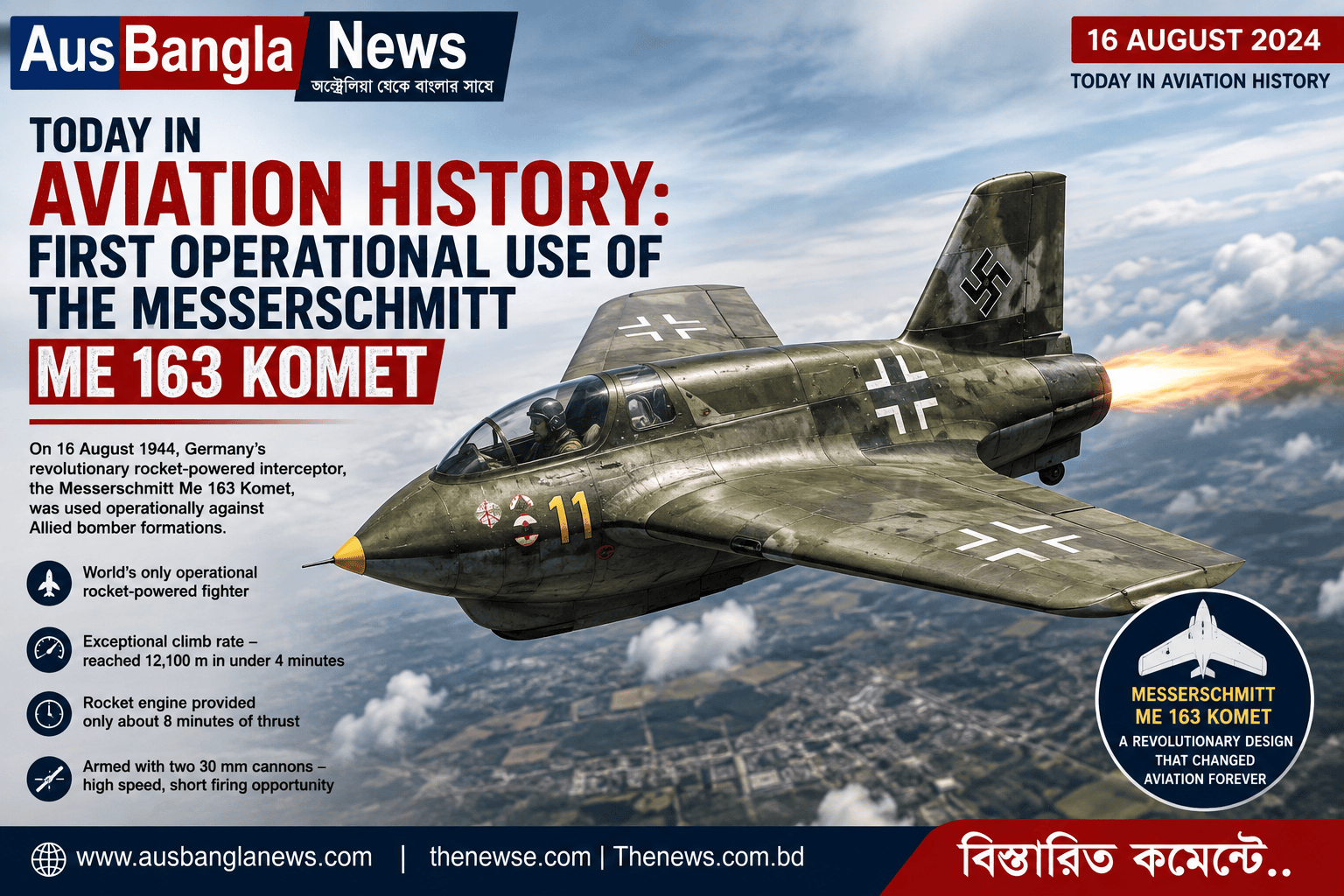

16 August 1944 marked a remarkable moment in aviation history when Germany’s revolutionary Messerschmitt Me 163 Komet rocket-powered interceptor was used operationally against Allied bomber formations during the Second World War.
The Me 163 was unlike almost any combat aircraft before or since. Powered by a rocket motor rather than a conventional piston or jet engine, the small, tailless fighter was designed to climb at extraordinary speed and intercept Allied heavy bombers attacking Germany.
On 16 August 1944, aircraft of Jagdgeschwader 400 (JG 400) intercepted formations of American B-17 Flying Fortress bombers. The encounter represented the operational combat emergence of what became history’s only rocket-powered fighter aircraft to see combat service.
Extraordinary Performance
The Komet possessed an exceptional rate of climb and could reach approximately 12,100 metres (39,700 feet) in less than four minutes. Its rocket engine, however, provided powered flight for only around eight minutes.
Once its fuel was exhausted, the aircraft effectively became a high-speed glider, leaving its pilot vulnerable while returning to base.
The Me 163 was armed with powerful 30 mm cannons, but its tremendous speed created an unexpected problem: pilots had only a very short opportunity to aim and fire while passing through Allied bomber formations.
Revolutionary — But Extremely Dangerous
Although technologically advanced, the Komet was also exceptionally hazardous.
Its volatile rocket propellants, difficult handling characteristics, short endurance and unusual skid landing system contributed to numerous accidents. Allied fighter pilots also learned to wait until the Komet had exhausted its rocket fuel before attempting to attack it.
Despite its extraordinary performance, the Me 163 ultimately had only a limited impact on the air war over Europe.
A Unique Place in Aviation History
The Messerschmitt Me 163 Komet remains one of the most extraordinary experimental combat aircraft ever placed into operational service.
It demonstrated both the possibilities and the enormous challenges of rocket-powered aviation. More than eight decades later, its radical design and remarkable performance continue to make the Komet an important chapter in the history of military aviation.























আপনার মতামত লিখুন :