


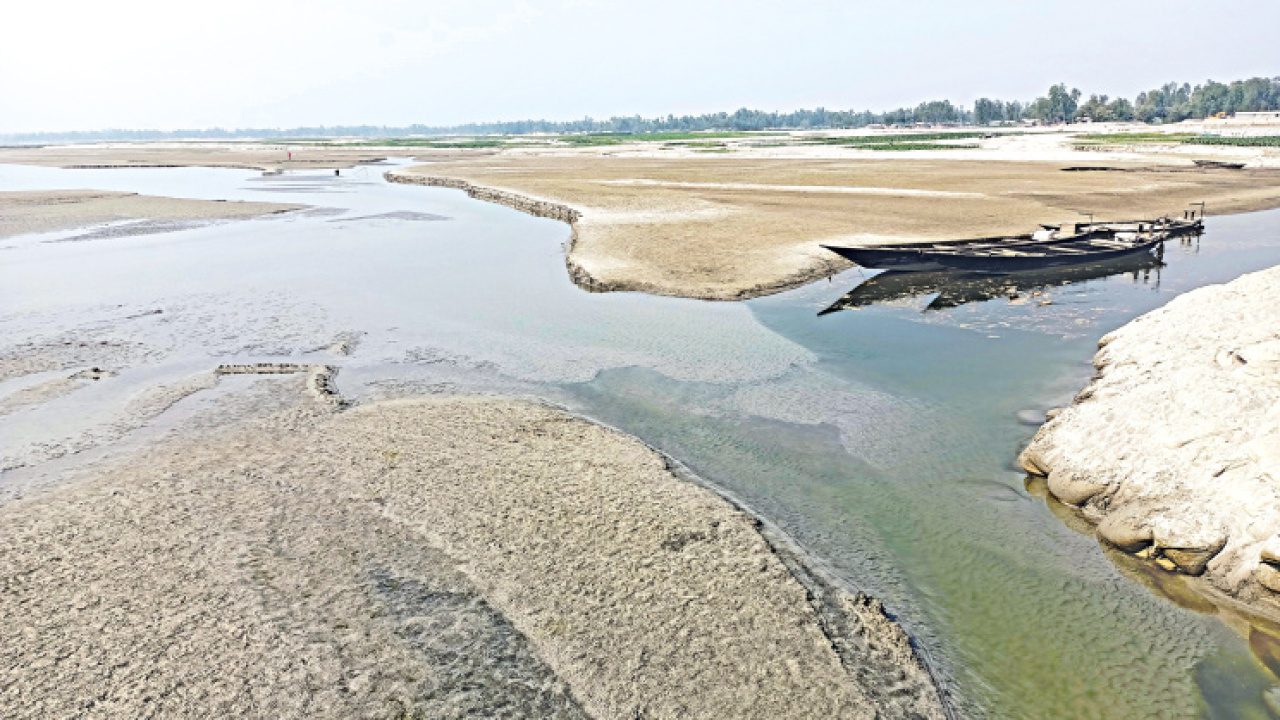

In Debesh Roy’s novel Teesta Parer Brittanto, a government survey begins at the riverbank. Suhas, the survey officer, works with Priyanath and Binodbabu to map the land. Pencil, plot numbers, and survey lines try to pin the Teesta to paper, but the riverbank has already defected from cadastral control. Gayanath, a local jotdar, watches. He owns land. He understands property and bureaucracy. As the survey nears completion, he approaches Suhas: ‘Sir, have you finished the map?’ The map is nearly done. But Gayanath’s question is not innocent. ‘Is the river breaking?’ he asks. A river that breaks banks, that erodes land, that creates chars and drowns forests cannot be fixed on a map. The question smuggles in a harder doubt: Is the river still moving? Still alive? The surveyors have drawn the river in one location. Gayanath names what they have done: ‘Where you have drawn the river, there is no river. This is a forest.’ The map describes a dead thing and calls it a river. But a river is what moves. A river is what breaks. Who decides what the river is? The surveyor draws his lines. Gayanath contradicts. Yet the Teesta continues its work of erasure.
On 3 October 2023, the wall of South Lhonak, a glacial lake in Sikkim destabilised by warming temperatures, collapsed. Water and sediment roared down the mountain. In hours, 270 million cubic metres of sediment entered the Teesta’s course. The Teesta III hydropower dam was destroyed, and several other dams along the Teesta River were damaged. The disaster caused 55 deaths, and 74 persons were reported missing in Sikkim. In one night, the Teesta shattered assumptions that had gestated across decades: that engineers can manage what nature generates, that maps can contain what lives. No treaty can step around this moment.
The barrage scheme requires at least 4,500 cusecs during the dry season to sustain agriculture across northern Bangladesh, flows have collapsed to near 400.
1 In Roy’s fictional world, Gayanath had already understood what modern diplomacy still struggles to acknowledge. The Teesta delivered its answer in sediment, shattered concrete, and human loss. The old quarrel between map and river is no longer a matter of interpretation; it has become a catastrophe. The question before India and Bangladesh is no longer only how much water each side receives. The question is whether the Teesta can continue to exist as a river.
2 For fifteen years, Bangladesh heard a familiar explanation for why the Teesta treaty remained unsigned. Delhi wanted it. Kolkata blocked it. Chief Minister of West Bengal Mamata Banerjee stood between diplomacy and water. On 4 May 2026, West Bengal voted for a new government. Suvendu Adhikari, the BJP candidate, defeated Mamata Banerjee in her own constituency. He took the oath of office as Chief Minister on 9 May. Mamata Banerjee’s veto is over. But Bangladesh should not mistake a cleared corridor for a flowing river. One blockade has moved; the Teesta has not returned.
Photo: S Dilip Roy








আপনার মতামত লিখুন :