


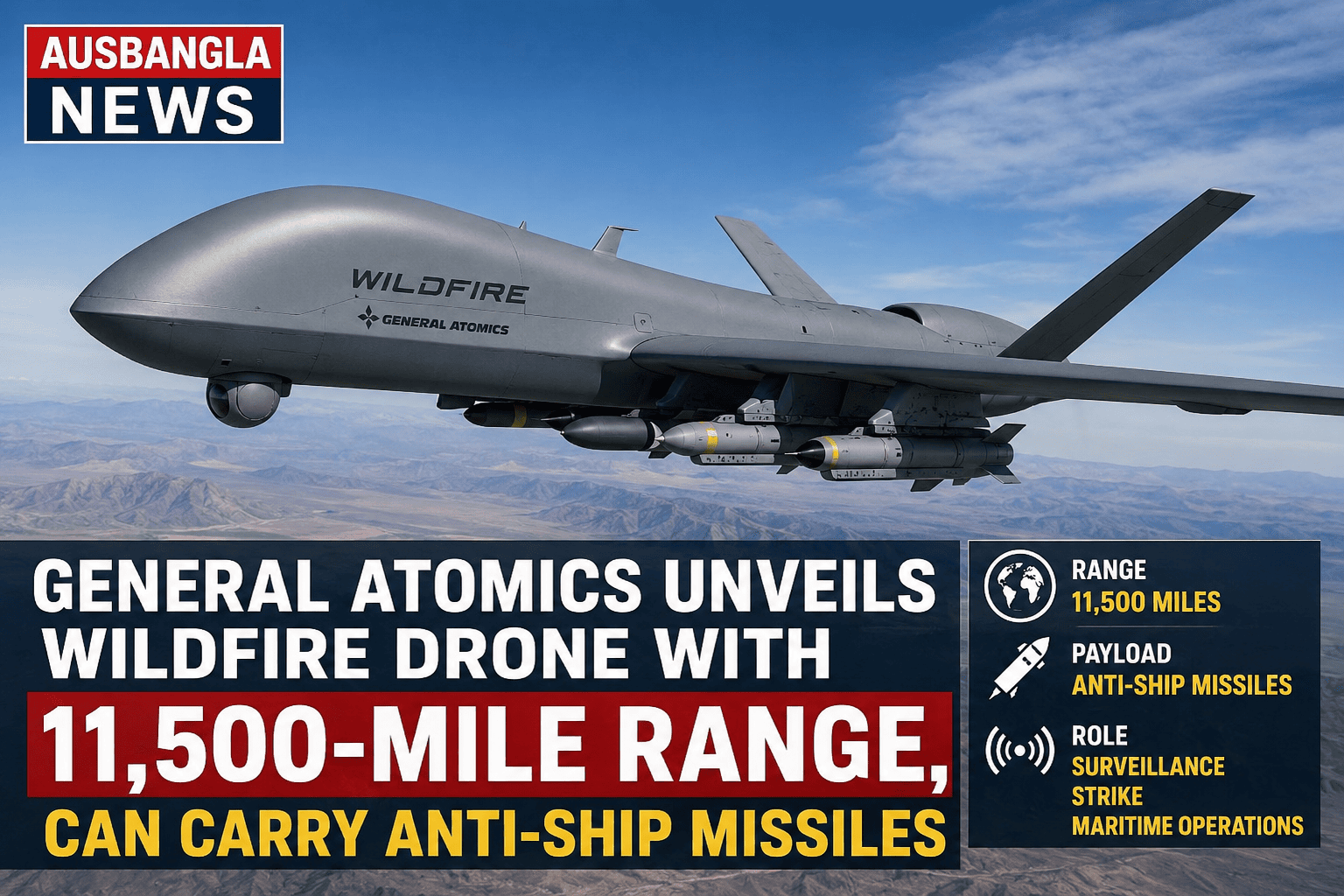

US defence and aerospace company General Atomics has unveiled a new unmanned aircraft concept called Wildfire, a next-generation long-range drone designed to offer significantly greater reach, payload flexibility and combat capability than existing platforms.
The Wildfire Unmanned Aerial System is being positioned as a potential successor to the widely used MQ-9 Reaper, as the United States looks toward a new generation of medium-altitude, long-endurance unmanned aircraft that can be produced more economically and operated in increasingly contested environments.
Extraordinary 11,500-Mile Reach
One of Wildfire’s most striking proposed features is its range. Reports indicate the aircraft is designed for a range of around 10,000 nautical miles — approximately 11,500 miles (18,500 kilometres). Such reach could allow the drone to conduct extremely long-distance missions while reducing its dependence on bases close to potential conflict zones.
This capability could be particularly significant for operations across the vast distances of the Indo-Pacific, where aircraft range, endurance and access to secure bases have become increasingly important considerations for US and allied military planners.
Potential to Carry Anti-Ship Missiles
Wildfire is also being designed with substantial weapons-carrying potential. Reports suggest a configuration could carry four AGM-158C Long Range Anti-Ship Missiles (LRASM), giving the unmanned aircraft a potentially powerful maritime strike role.
General Atomics has separately been developing long-range weapon integration for its existing MQ-9B family, including the LRASM, Joint Air-to-Surface Standoff Missile (JASSM) and Joint Strike Missile (JSM). The company has said it plans to flight-test at least one of these long-range weapons as early as 2026.
Designed for the Post-Reaper Era
The MQ-9 Reaper has served for years as one of America’s best-known unmanned surveillance and strike aircraft.
However, future conflicts could involve much more sophisticated air-defence systems, creating demand for drones that are cheaper, more modular and easier to replace if lost.
Wildfire represents General Atomics’ attempt to address that changing battlefield environment. The concept has been entered into a new Pentagon competition seeking a next-generation medium-altitude, long-endurance platform for intelligence, surveillance, reconnaissance and combat missions.
Another important element could be the ability to operate alongside other unmanned systems. General Atomics has indicated that Wildfire could potentially incorporate advanced autonomous and swarm-related capabilities, allowing one platform to coordinate with multiple drones during complex missions.
Strategic Importance
If developed and deployed at scale, Wildfire could represent a major evolution in unmanned warfare. Combining very long range with surveillance capabilities and stand-off weapons could enable drones to operate across enormous areas while keeping human aircrews away from some of the most dangerous missions.
However, Wildfire remains a developing concept, and its final specifications, weapons configuration, procurement numbers and operational timeline have not yet been confirmed.
The unveiling nevertheless highlights how rapidly military aviation is moving toward long-range, autonomous and heavily armed unmanned aircraft, potentially reshaping air and maritime warfare in the coming decade.
























আপনার মতামত লিখুন :