


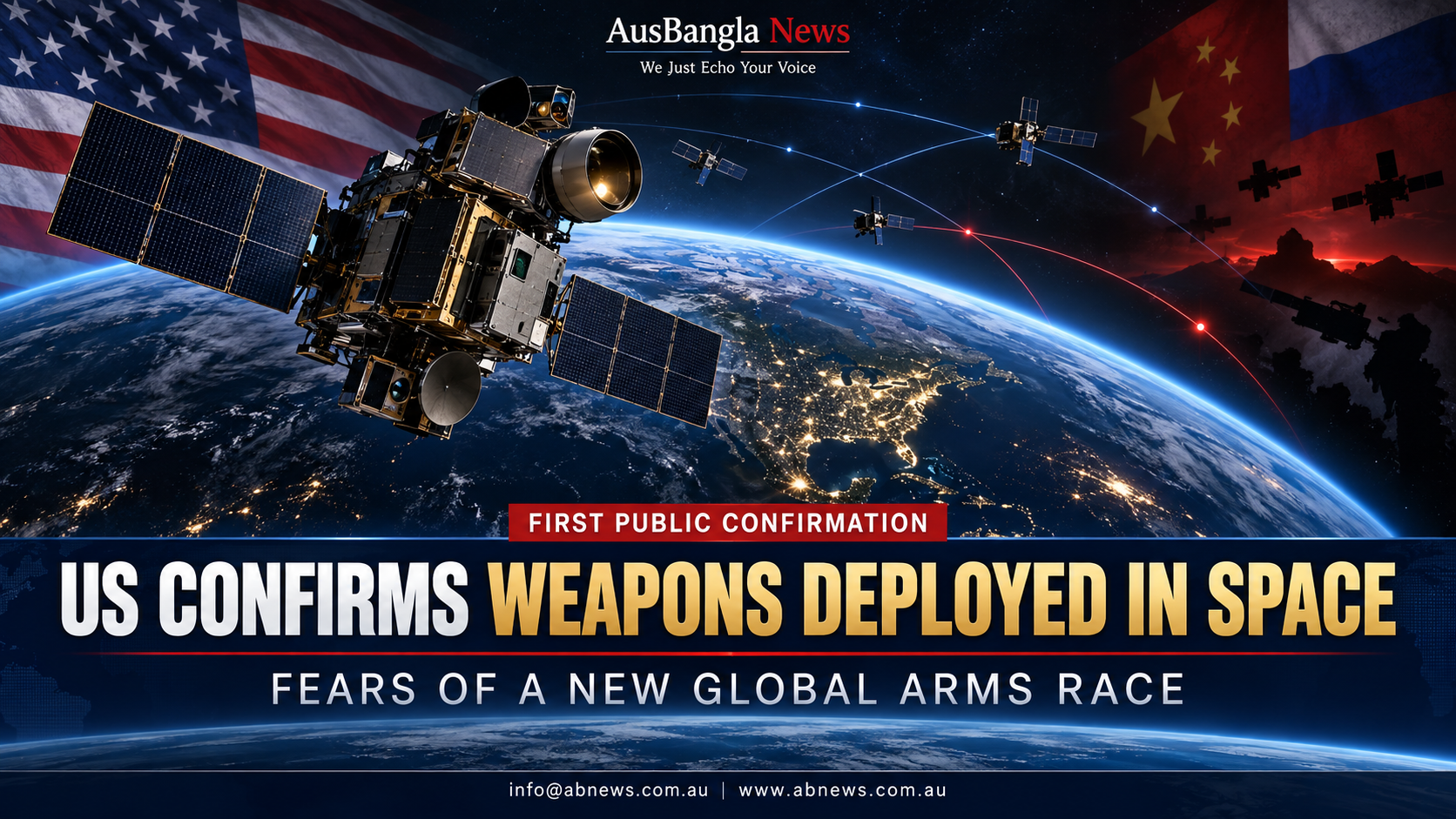

The United States has publicly confirmed for the first time that it has deployed weapons in Earth’s orbit, marking a significant shift in how the Pentagon discusses its military capabilities in space.
US Air Force Secretary Troy Meink made the announcement at the Air, Space and Cyber Conference in Maryland. He said the United States now has “on-orbit space control weapons” intended to protect American and allied forces from hostile action.
However, officials have not disclosed what the weapons are, when they were deployed, how many are operating, or whether they use kinetic or non-kinetic technology.
The announcement represents the first explicit public acknowledgment by a senior Pentagon official that American weapons are already stationed in orbit. It does not establish when the systems were first deployed.
“Space-control” technology could potentially include jammers, lasers, microwaves, robotic spacecraft or systems capable of interfering with another satellite. US officials have not confirmed which, if any, of these technologies are involved.
They also have not said whether the systems are designed exclusively for defence or could be used offensively against an adversary’s satellites.
Washington has repeatedly warned that China and Russia are developing capabilities that could threaten American satellites.
Modern military operations depend heavily on satellites for communications, navigation, intelligence, missile detection and targeting. Civilian services—including banking, weather forecasting, internet connections and emergency communications—also rely on orbital infrastructure.
US officials argue that publicly disclosing the new capability may discourage adversaries from attacking American space assets. Critics warn that the announcement could instead encourage China, Russia and other powers to accelerate their own weapons programs. Reuters
Russia criticised the American disclosure, warning that military competition in orbit could endanger the satellites supporting economic and civilian life worldwide.
Moscow accused Washington of ignoring the potentially catastrophic consequences of armed conflict in space and said it would continue promoting United Nations resolutions against placing weapons in orbit. Reuters
China has also repeatedly opposed what it describes as the weaponisation of space, although Washington accuses both Beijing and Moscow of developing counter-space systems.
The 1967 Outer Space Treaty prohibits placing nuclear weapons or other weapons of mass destruction in orbit. It does not impose a comprehensive ban on every conventional weapon or non-kinetic military system in space.
This legal gap has allowed military satellite operations and counter-space technology to develop without a universally accepted treaty banning all orbital weapons.
Russia vetoed a US–Japan-backed UN Security Council resolution in 2024 that sought to reinforce the prohibition against nuclear weapons in space. A separate Russian proposal calling for a broader ban on all space weapons also failed.
The disclosure comes as the Trump administration advances its proposed Golden Dome missile-defence system. The plan includes developing space-based interceptors capable of detecting and potentially destroying missiles.
The US Congressional Budget Office has estimated that the space-based elements alone could cost as much as US$542 billion over 20 years, depending on their design and scale.
A conflict involving satellites could create long-lasting orbital debris. Even small fragments travel at extremely high speeds and can damage spacecraft, communication satellites and crewed missions.
Non-destructive attacks—such as jamming, cyber interference or temporarily disabling a satellite—could still disrupt GPS, aviation, financial networks and emergency services.
The American announcement may be intended as strategic deterrence, but its lack of detail creates uncertainty. That uncertainty could drive rival powers to assume the most dangerous scenario and expand their own capabilities, increasing fears of a new arms race above Earth.





















আপনার মতামত লিখুন :