


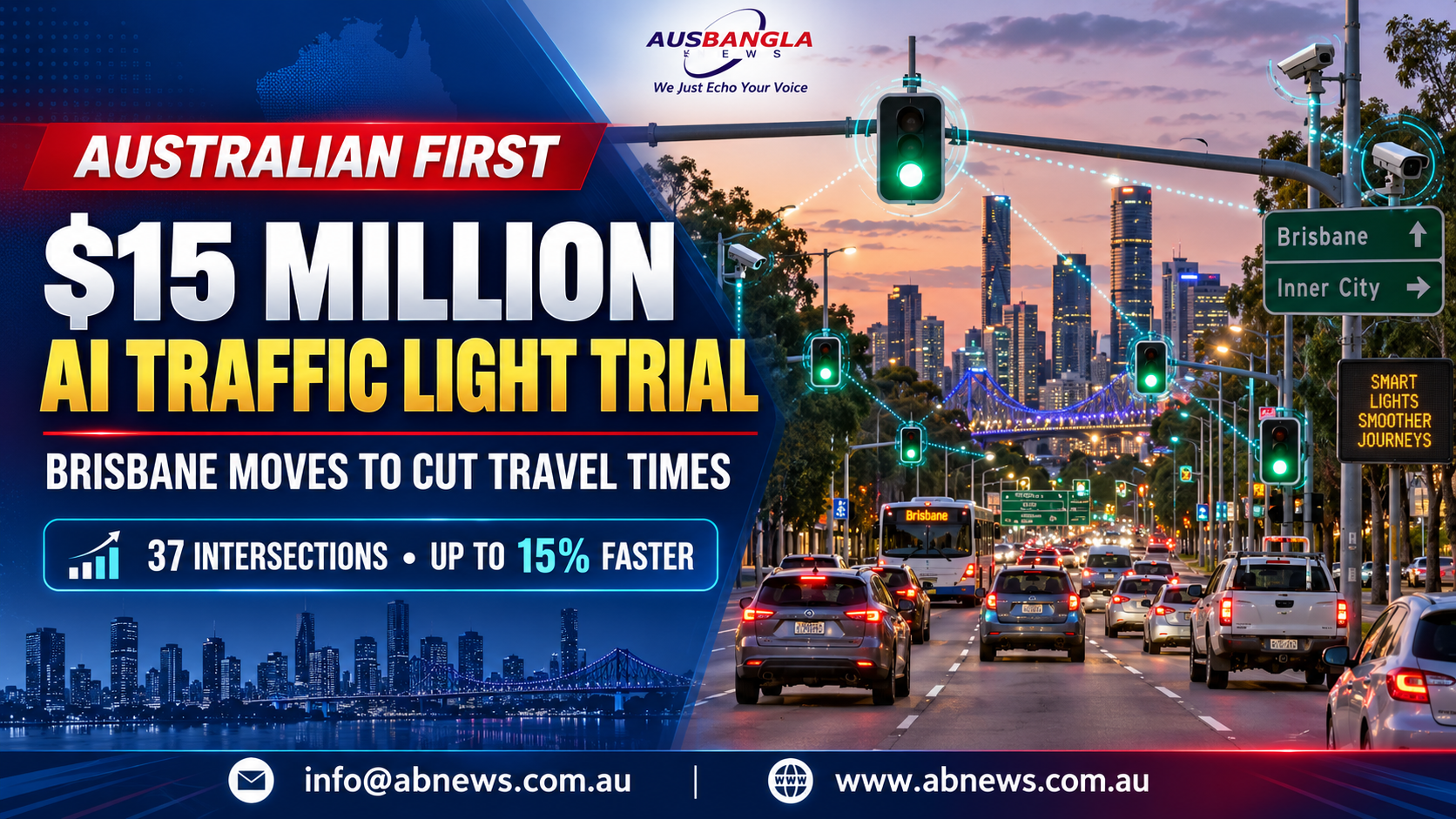

Brisbane is preparing to launch a major $15 million artificial intelligence-powered traffic light trial designed to reduce congestion, shorten queues and improve road safety.
Billed by Brisbane City Council as an Australian first, the technology will coordinate traffic signals across two of the city’s busiest road corridors rather than operating at only one intersection.
The six-month trial is expected to begin in early 2027 and will cover 37 intersections—22 along Logan Road and 15 within the Kelvin Grove Road corridor.
Cameras installed at intersections will identify different road users, including cars, trucks, buses, cyclists and pedestrians. The system will monitor traffic volumes and queue lengths in real time before calculating the most efficient traffic-light sequence.
Unlike conventional phase-based traffic signals, the AI-assisted system will continuously learn from traffic patterns and recommend adjustments to operators.
It will also be able to respond to changing conditions, such as bad weather, peak-hour congestion and major events, including football matches.
Brisbane City Council Transport Chair Ryan Murphy said the technology would operate on top of the existing traffic infrastructure, allowing the council to manage the transport network more actively.
The system could also prioritise different road users depending on the location and time. For example, signals could favour pedestrian movements in the CBD or freight traffic along an industrial corridor.
Council modelling suggests the technology could deliver several benefits, including:
More than 92,000 vehicles reportedly travel along the two selected corridors each day.
The council says human operators will continue to oversee the system and retain control over traffic-management decisions.
Faces and vehicle number plates captured by cameras will be blurred, while collected data will be stored locally in Brisbane and will not be sent overseas.
If the trial is successful, the technology could eventually be expanded across Brisbane City Council’s network of approximately 1,000 intersections.
RACQ has welcomed the trial, saying technology capable of coordinating an entire road network could provide greater benefits than systems operating at individual intersections.
However, Brisbane’s Labor opposition cautioned that AI traffic signals alone would not solve the city’s congestion problems, arguing that continued investment in public and active transport would also be necessary.
The initiative represents a significant test of whether artificial intelligence can make daily journeys faster, safer and more predictable without requiring major reconstruction of existing roads.


















আপনার মতামত লিখুন :