



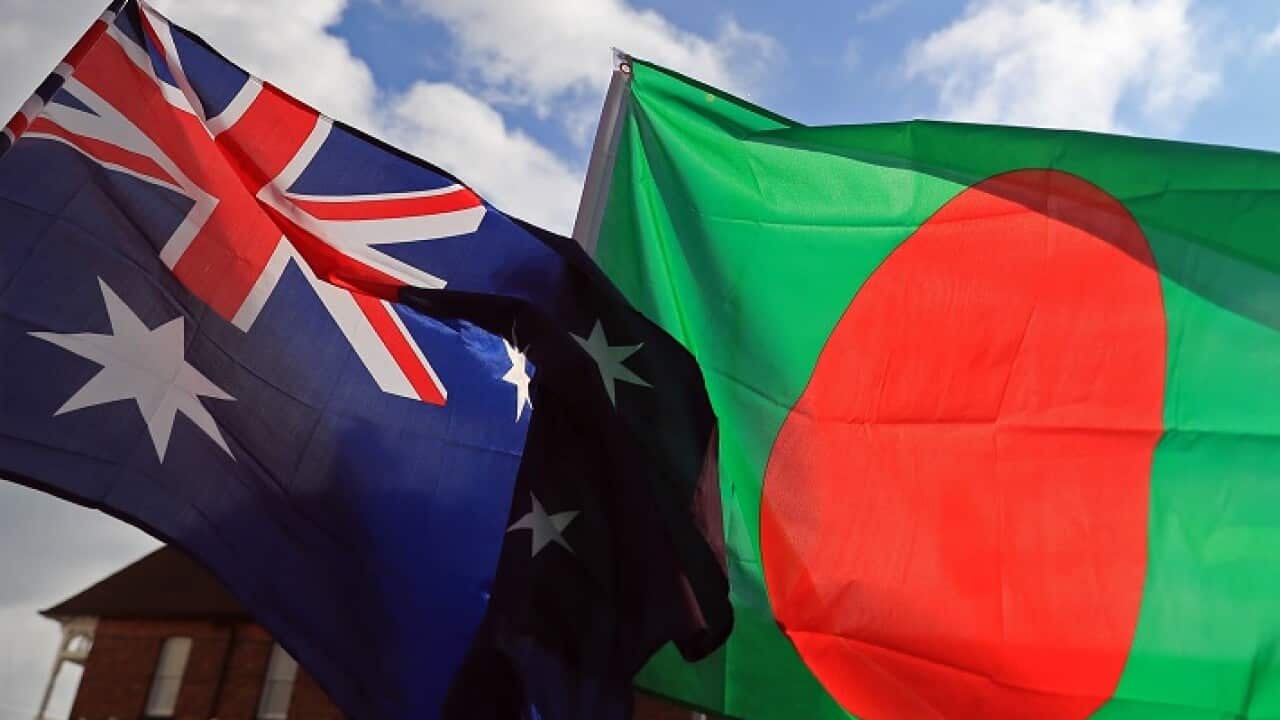
China has test fired a nuclear-capable missile armed with a dummy warhead in the South Pacific just hours after Australia and Fiji inked a mutual defence pact that could grow to include other countries in the region.
Chinese state media reported that a nuclear submarine fired the missile at noon (Beijing time) on Monday and that it “landed precisely within the designated waters”.
Speaking to reporters in Fiji, Foreign Minister Penny Wong confirmed the projectile was “sea-based”.
“This underscores the need for countries of the region to work together,” she said.
“This underscores the imperative of countries of the region to work together to ensure that it is Pacific countries who determine our futures if we want the Pacific to remain an ocean of peace.
“Australia has been clear with China that we regard this as destabilising to the region.”
Senator Wong would not “speak to China’s intent”, but said Australia had been “aware” of a Chinese task group “in the region for some time”.
CHINA-BEIJING-V-DAY COMMEMORATIONS-GATHERING (CN)
China has massively expanded its nuclear arsenal over the past six years. Picture: IMAGO
Fronting a long-delayed press conference at around the same time, Deputy Prime Minister and Defence Minister Richard Marles said Canberra was “very concerned about any actions which undermine the stability, the peace and security of the Pacific”.
“We are completely committed to the Oceans of Peace declaration that was made by the Pacific Island Forum last year on maintaining peace and security of the Pacific,” he said.
China has massively expanded its nuclear arsenal since the state of the decade.
As of mid-2024, China’s operational nuclear warheads exceeded 600, according to the US Department of Defence.
That was nearly triple what the country was estimated to have in 2020.
Mr Marles last year admitted China’s nuclear build-up was driving “security anxiety” in Australia.
“We’ve made that clear to China itself,” he said at the time.
Chinese President Xi Jinping has overseen the biggest military build-up in the People’s Liberation Army’s history.
Beijing has not kept secret its unease about Australia’s engagement in the Pacific and has tried to sink pacts, such as the delayed Nakamal Agreement struck with Vanuatu last week.
The deal was to be signed last year but members of Vanuatu’s government feared China would cut funding.
Under the Ocean of Peace Alliance signed with Fiji on Monday, the Australian and Fijian governments must “consult” on whether action should be taken if either country’s “sovereignty, peace, or stability” is threatened.
It also requires that both nations recognise an armed attack on any nation within the Pacific would be “dangerous to each other’s peace … declares that it would act to meet the common danger, and declares that it would act to meet the common danger, in accordance with its domestic processes”.
At a joint press conference in the Fijian capital Suva, Anthony Albanese touted the pact as “one of the most significant endeavours Australia has ever undertaken in our history with any country”.
“We can achieve this level of ambition because we are Vuvale – (meaning) family – with a relationship grounded in loyalty, in understanding, and mutual respect, and in a more uncertain world,” he said.
Shadow foreign affairs minister Ted O’Brien said the missile launch was “unwelcome news”.
“This is irresponsible, and it is not welcomed. On the very day that Australia is joining with one of its closest Pacific island neighbors to talk about an ocean of peace, the People’s Republic of China has chosen to lob a missile into the region,” he said.












আপনার মতামত লিখুন :