


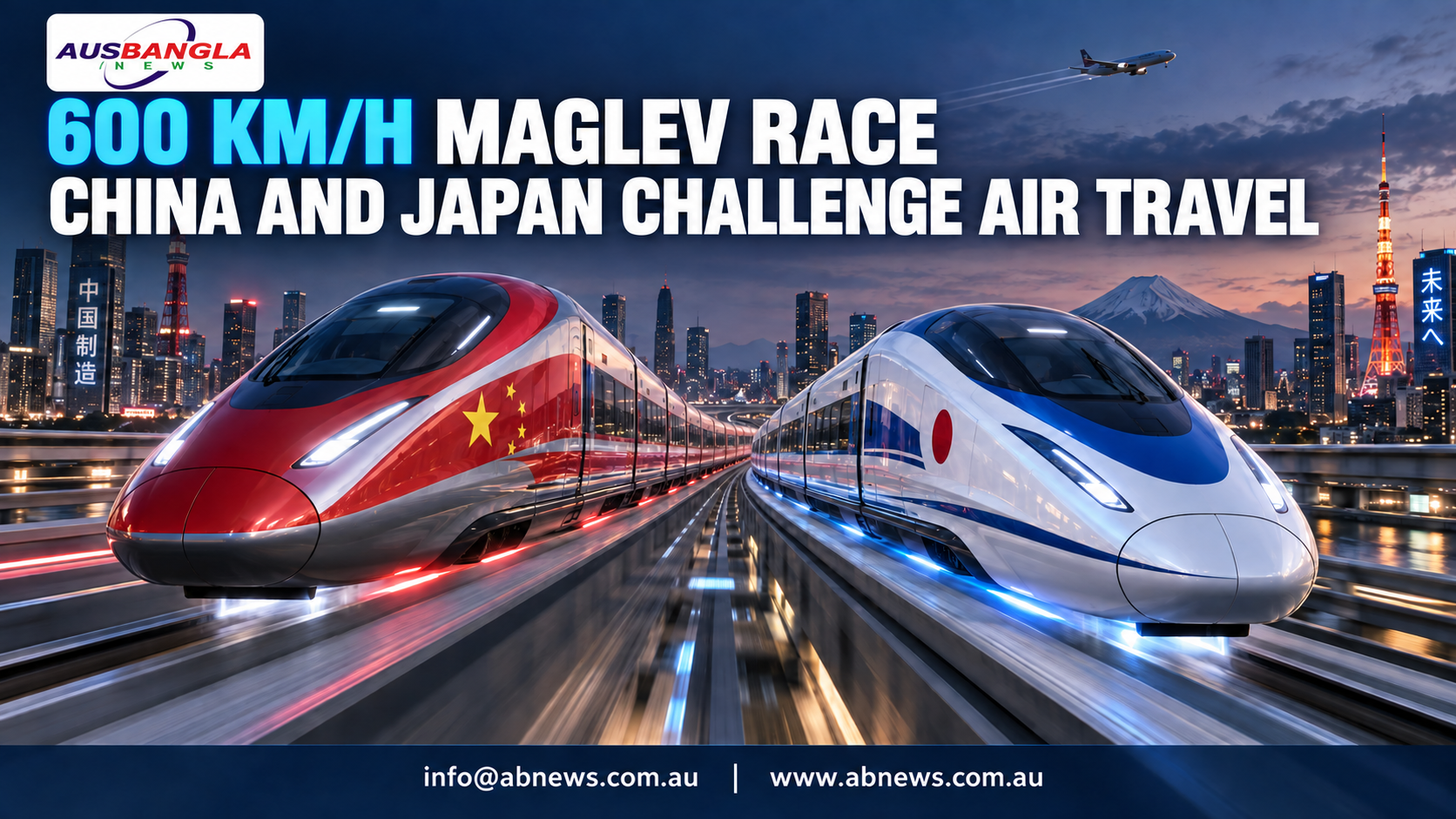

China and Japan are accelerating their efforts to develop a new generation of magnetic-levitation trains capable of travelling at around 600 kilometres per hour—raising the possibility that ultra-fast rail could eventually compete with air travel on busy regional routes.
Unlike conventional trains, maglev vehicles use powerful magnetic forces to lift above their guideways. By eliminating direct contact between wheels and rails, the technology dramatically reduces friction and allows trains to travel at extraordinary speeds while providing a smoother and quieter journey.
Japan currently holds the world record for a crewed train. Its L0 Series superconducting maglev reached 603km/h during a test run in 2015. The train is being developed for the Chuo Shinkansen line, which will initially connect Tokyo’s Shinagawa Station with Nagoya.
Commercial services are expected to operate at about 500km/h, reducing the approximately 286-kilometre Tokyo–Nagoya journey to around 40 minutes. However, the project has suffered significant delays because of environmental concerns, complex tunnel construction and rising costs.
JR Central has provisionally used 2035 as the opening year for financial planning, but the company stresses that this is not yet a confirmed launch date. The estimated construction cost for the Tokyo–Nagoya section has climbed to about ¥11 trillion.
China, meanwhile, is developing its own 600km/h maglev transport system. State-owned manufacturer CRRC unveiled a prototype with a designed top speed of 600km/h in Qingdao in 2019. The technology is intended to bridge the speed gap between existing high-speed rail and commercial aviation.
China has also reported major breakthroughs in experimental magnetic-propulsion research. In December 2025, a 1.1-tonne model vehicle reached 800km/h in just 5.3 seconds on a one-kilometre test track in Hubei province. However, this was a specialised research vehicle—not a full-size passenger train ready for commercial operation.
Supporters believe 600km/h maglev services could compete strongly with flights covering distances of up to about 2,000 kilometres. Although passenger aircraft travel faster while airborne, air journeys also involve airport transfers, security checks, boarding procedures and baggage collection. City-centre-to-city-centre maglev services could therefore offer a shorter overall journey on selected routes.
A future Beijing–Shanghai maglev service, for example, could potentially cut the journey to between two-and-a-half and three hours, compared with roughly four hours on existing high-speed trains.
However, major obstacles remain. Maglev trains require dedicated guideways and cannot generally operate on conventional railway tracks. Building new tunnels, stations and power systems involves enormous investment, while engineers must also address energy use, emergency evacuation, noise and pressure waves created when trains enter and leave tunnels at extreme speeds.
Despite these challenges, the competition between China and Japan is rapidly advancing rail technology. Japan is moving forward with a defined intercity project, while China is combining commercial-scale prototypes with increasingly ambitious experimental research.
The 600km/h railway era has not yet arrived for ordinary passengers. But if the technical, financial and environmental challenges can be overcome, maglev trains may fundamentally reshape regional travel—and provide airlines with a powerful new competitor.






















আপনার মতামত লিখুন :