


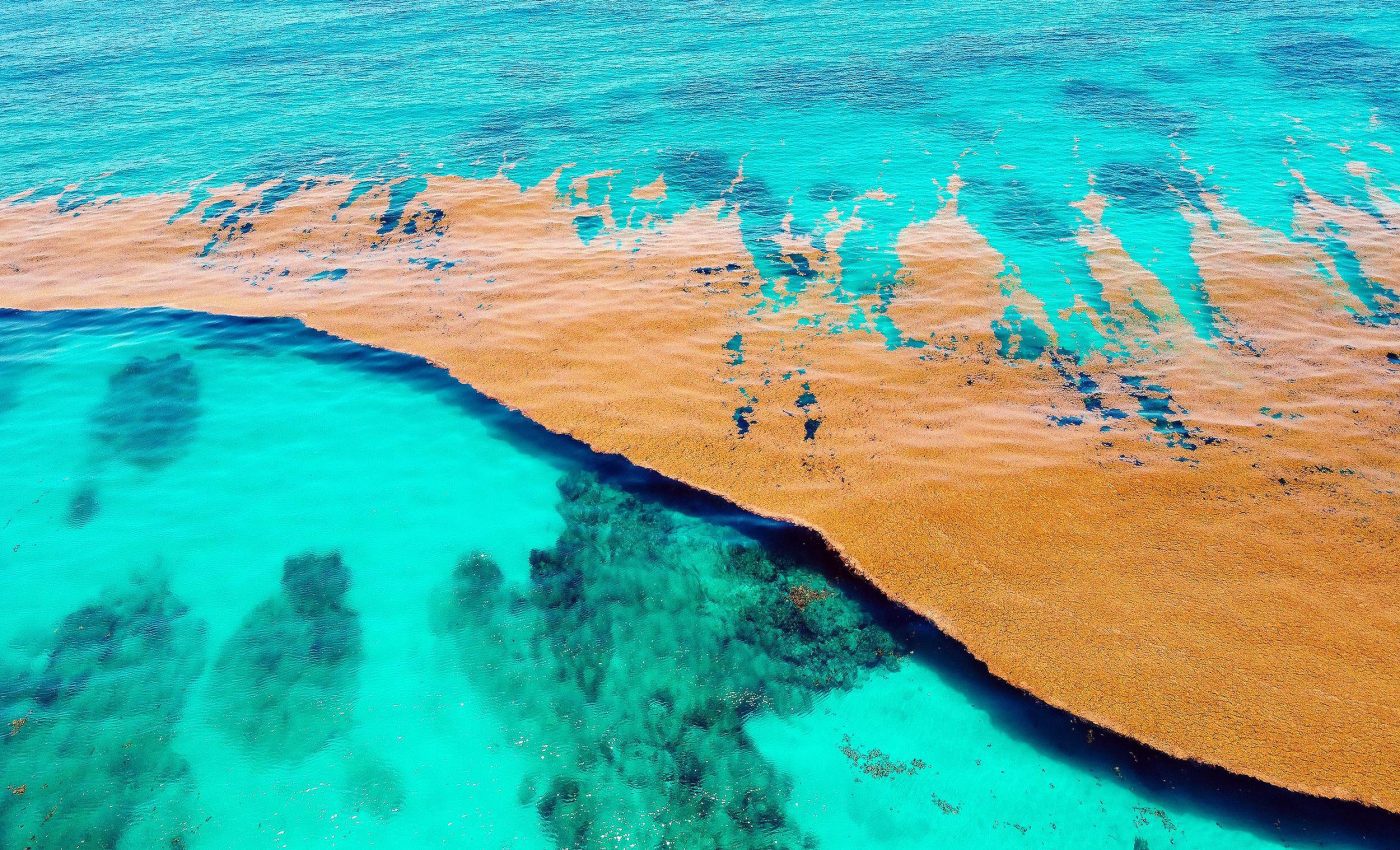

The Atlantic Ocean holds a secret: a patch of calm water ringed by swift currents, sitting about 590 miles east of Florida yet never touching land. Known as the Sargasso Sea, sailors have crossed it for centuries, but few notice the border when they slip into glassy indigo waters.
Those who linger find the surface scattered with golden-brown seaweed – Sargassum – named for the Portuguese word sargaço, a type of grape-like algae. The plants bob in slow motion, rolling gently like tumbleweeds on a prairie of water.
Within minutes, the stillness feels uncanny. No surf pounds. No gulls scream from cliffs. The seaweed, however, bursts with residents: shrimp the size of rice grains, neon juvenile fish, porcelain-white crabs, and even young loggerhead turtles paddling their first miles of life.
This floating cover grows so thick that early Spanish crews feared their wooden caravels would halt and “never again feel a breath of wind,” as Christopher Columbus wrote in 1492.
The Sargasso Sea has a drifting forest
Strip away the romance, and the Sargasso Sea looks like an 800-mile-wide nursery. Scientists call the drifting mats “habitat islands,” and for good reason. Hatchling turtles hide here until their shells harden.
Porbeagle sharks cruise the shade below, while Bermuda storm-petrels skim the fringe, plucking shrimp in mid-dive.
Researchers have counted more than 100 invertebrate species clinging to the weed—tiny colonists that hitch a ride for years before the mats eventually break apart.
Life cycles in migration
European and American eels begin their lives beneath these mats, no bigger than clear threads. They drift west or east on ocean currents, slip into rivers as far inland as Indiana, then, after decades in freshwater, swim back the entire 3,000-mile journey to spawn once and die.
How they locate the same watery cradle baffles zoologists. Humpback whales also cross the sea each spring, and high-speed tuna streak through on their way to spawning grounds.
Unique climate engine
Longtime observers quickly learn that calm water masks heavy lifting. In summer, the surface warms to about 82–86 °F; in winter, it cools to roughly 64–68 °F.
Those seasonal swings drive mixing that helps push warm, salty water northward and return cooler water south – a conveyor that steadies weather patterns on both sides of the Atlantic.
The open water also pulls carbon dioxide from the air, locking it into plankton shells that eventually snow to the seafloor.
Only after two years of sampling did chemical oceanographer Nicholas Bates and colleagues at the Bermuda Institute of Ocean Sciences realize just how much heat the sea was absorbing.
“The ocean is the warmest it’s been for ‘millions and millions of years,’” he told LiveScience, warning that the trend could reshape “where it rains or where it doesn’t.”
Humans threaten the Sargasso Sea
Jules Verne once called the Sargasso “a perfect lake in the open Atlantic.” Today that lake collects trash from four converging currents: the North Atlantic Current, Canary Current, North Equatorial Current, and Antilles Current.
Those loops act like a mile-wide drain, funneling plastic bags, bottle caps, and ghost fishing gear into a slowly rotating slick.
One survey estimated roughly 200,000 pieces of debris per square kilometer – about 518,000 pieces per square mile – spreading for several hundred miles.
Underwater microphones pick up the growl of cargo vessels cutting straight through mats. Propellers shred the weed; paint chips flake from hulls, releasing copper and zinc.
Noise can mask the low-frequency calls of sperm whales passing beneath. Meanwhile, floating nets entangle juvenile turtles exactly where they once found refuge.
Tracking change through decades
Researchers have monitored these waters near Bermuda since 1954, recording temperature, salinity, dissolved oxygen, and pH every month.
Instruments show that winter water is slightly saltier than summer water, thanks to dry winds that whisk moisture off the surface, while rainfall each June and July freshens the mix.
Since the 1980s, the average temperature has climbed roughly 1 °C – a small number that packs a punch. Warmer layers resist vertical mixing, starving deeper water of oxygen and hoarding nutrients that would normally rise to feed plankton blooms.
There is one sea on Earth that touches no land, and that is because it has no shore
03-17-2026 There is one sea on Earth that touches no land, and that is because it has no shore.
@ Eric Ralls, Staff writer, earth.com




















আপনার মতামত লিখুন :